

product Details
Explore More
Alternatives
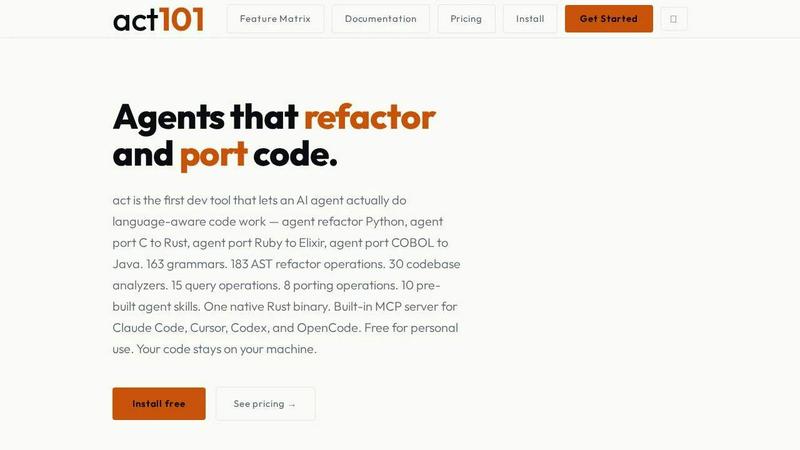
About act101
act101 is an innovative development tool that empowers AI agents to refactor and port code across an impressive spectrum of 163 programming languages. Unlike traditional tools that only provide theoretical support for code refactoring, act101 allows agents to perform actual code modifications in a language-aware manner. This is achieved through a combination of 183 abstract syntax tree (AST) refactor operations, 30 codebase analyzers, and 8 porting operations, all of which are accessible through a built-in Model Context Protocol (MCP) server. The primary audience for act101 includes software developers, DevOps engineers, and organizations seeking to streamline their code maintenance and migration processes. The main value proposition of act101 lies in its ability to execute complex code transformations accurately while ensuring cross-file consistency and maintaining code quality, making it an essential tool in any developer's toolkit.
Features
Agent Refactor
The agent refactor feature allows users to perform sophisticated code modifications across 163 languages, including Python, Rust, and TypeScript. With 183 AST-aware operations available, users can execute tasks like symbol renaming, function extraction, and type hinting while ensuring consistency throughout the codebase. Each operation comes with automatic checkpoints and instant undo capabilities, providing a safety net for developers during the refactoring process.
Agent Port
The agent port functionality enables seamless migration of code from one language to another, such as converting C code to Rust or Ruby to Elixir. By utilizing a structured porting process that includes contract anchoring, inventory enumeration, and dependency resolution, users can manage complex language transitions with ease. This feature simplifies the often cumbersome task of cross-language code migration, making it more efficient and less error-prone.
Agent Analyze
With the agent analyze capability, developers can gain insights into their codebases through 30 different analyzers that evaluate aspects like coupling, cycles, and dead code. This feature provides a structural map of the repository prior to any modifications, allowing developers to identify potential issues and optimize their code before making changes. This level of analysis is crucial for maintaining a healthy and efficient codebase.
Agent Skills
act101 includes 10 pre-built agent skills that help automate common engineering workflows such as architecture audits, code reviews, and migration assessments. By invoking specific skills, users can streamline their processes and focus on high-level decision-making rather than repetitive tasks. These skills can be easily integrated into the workflow, enhancing productivity and ensuring best practices are followed.
Use Cases
Code Refactoring for Legacy Systems
Developers maintaining legacy codebases can utilize act101 to refactor outdated code efficiently. By leveraging the agent refactor feature, they can systematically improve the code structure, enhance readability, and update outdated practices without losing critical comments or formatting.
Language Migration for Modernization
Companies looking to modernize their applications can use act101 to port legacy systems written in older languages like COBOL to more contemporary ones like Java. This use case highlights the tool's ability to facilitate significant technology shifts, enabling organizations to take advantage of modern programming paradigms and libraries.
Codebase Analysis for Optimization
Teams can employ the agent analyze feature to assess their codebases for potential improvements. By identifying hotspots, dead code, and coupling issues, they can optimize performance and maintainability, leading to more efficient development cycles.
Collaborative Development Enhancements
In collaborative environments, act101 can be a game-changer by providing consistent code refactoring across multiple contributors. By ensuring that all changes are AST-aware and maintain cross-file consistency, the tool helps eliminate discrepancies that often arise in team projects, leading to smoother integration and deployment processes.
Frequently Asked Questions
What programming languages does act101 support?
act101 supports an extensive range of 163 programming languages, allowing developers to refactor and port code across a diverse set of coding environments, ensuring broad applicability.
How does act101 ensure code quality during refactoring?
act101 employs AST-aware operations that maintain code structure and integrity. With automatic checkpoints and an instant undo feature, developers can confidently refactor code while minimizing the risk of introducing errors.
Is act101 suitable for team collaboration?
Yes, act101 is designed for collaborative environments. Its features ensure consistent code quality across contributions, allowing teams to work together effectively without introducing discrepancies in the codebase.
What are the system requirements for installing act101?
act101 is delivered as a native Rust binary, ensuring it operates efficiently on supported systems with no additional runtime dependencies. For specific system requirements, users should refer to the installation documentation available on the act101 website.
Similar to act101


Product Launch Checklist
A free launch checklist for SaaS, apps, AI tools and more. Every step says why it matters and when you can skip it.

Forms Plugin
The #1 Native Form Builder Plugin for Framer - No Code, No Embeds, No External Platforms.

Chatit Me - Free Random Chat Alternative
Chat with random strangers online for free on ChatIt.me. Enjoy safe, anonymous, and instant 1-on-1 conversations with people worldwide


xDevTools
1000+ browser-based developer utilities. Format, encode, hash, and test data locally. No server uploads.