

product Details
Explore More
Alternatives
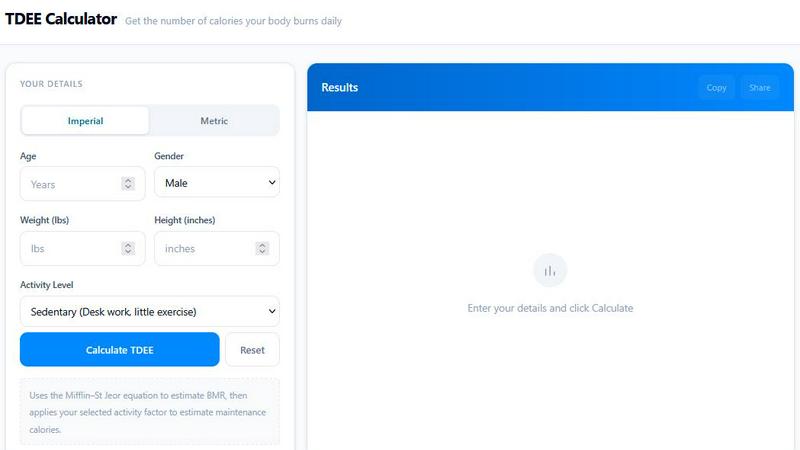
About TDEE Calculator
TDEE Calculator is a fast, accurate, and completely free online tool designed to help individuals estimate their Total Daily Energy Expenditure (TDEE) and plan their daily calorie intake with confidence. The tool is built for anyone who wants to take control of their nutrition, whether the goal is weight loss, muscle gain, or simply maintaining a healthy physique. By entering basic personal details including age, sex, height, weight, and activity level, users receive an instant calculation of their maintenance calories, along with practical targets for calorie deficits or surpluses. The calculator uses the scientifically validated Mifflin-St Jeor equation to estimate Basal Metabolic Rate (BMR), then applies an appropriate activity factor to produce reliable, physiology-based estimates. This approach removes guesswork and provides a trustworthy starting point for dietary planning. TDEE Calculator is designed for speed, clarity, and practical use, offering results in seconds without requiring registration or payment. The tool is ideal for fitness enthusiasts, athletes, individuals beginning a weight management journey, and anyone seeking a data-driven approach to nutrition. Beyond the core calorie estimate, TDEE Calculator provides valuable insights including calorie deficit and surplus recommendations, macro guidance, and activity-based adjustments. These features help users create a personalized plan that fits their lifestyle and goals. The tool emphasizes that its estimates are a starting point, encouraging users to track their results over two to three weeks and adjust their intake by small increments as needed. TDEE Calculator serves as an educational resource, helping users understand the relationship between energy balance, body composition, and performance.
Features
Instant Calorie Calculation
The core feature of TDEE Calculator is its ability to deliver an immediate, accurate estimate of your total daily calorie needs. By inputting your age, sex, height, weight, and activity level, the tool processes your data using the Mifflin-St Jeor equation to calculate your BMR, then multiplies that number by your selected activity factor. The entire process takes seconds, providing you with a clear maintenance calorie number that serves as the foundation for any nutrition plan. This speed and efficiency make it easy to check your numbers whenever your body weight or activity level changes.
Customizable Activity Levels
TDEE Calculator offers five distinct activity levels, ranging from Sedentary to Athlete, each with a specific multiplier. Sedentary (1.2) is for desk work with little exercise, while Light Exercise (1.375) covers gentle activity one to three days per week. Moderate Exercise (1.55) includes planned workouts three to five days weekly, and Heavy Exercise (1.725) applies to intense training six to seven days per week. The Athlete level (1.9) is for twice-daily training or very active occupations. This granularity allows users to select the option that most closely matches their actual lifestyle, improving the accuracy of their TDEE estimate.
Practical Calorie Targets
Beyond simply showing your maintenance calories, the tool provides actionable recommendations for fat loss and muscle gain. For individuals aiming to lose weight, TDEE Calculator suggests a daily calorie deficit of roughly 250 to 500 calories, which typically supports steady fat loss without compromising energy levels. For those looking to build muscle, the tool recommends a daily surplus of about 200 to 350 calories, a range that promotes muscle growth while minimizing excessive fat gain. These practical targets give users clear, achievable numbers to work with from day one.
Educational Insights and Guidance
TDEE Calculator is more than a number generator; it is an educational resource that helps users understand the science behind their results. The tool explains the concept of TDEE, the role of BMR, and how different activity levels affect total energy expenditure. It also provides guidance on how to use the estimate effectively, advising users to treat it as a starting point and to monitor their body weight over two to three weeks. If weight remains stable, the estimate is likely accurate; if weight changes, users are guided to adjust by 100 to 200 calories. This practical advice empowers users to refine their plan using real-world results.
Use Cases
Weight Loss Planning
Individuals seeking to lose weight can use TDEE Calculator to establish a precise calorie deficit. By first determining their maintenance calories, users can then subtract a recommended 250 to 500 calories per day to create a sustainable energy shortfall. This structured approach replaces guesswork with a data-driven target, helping users achieve steady fat loss while preserving muscle mass and metabolic health. The tool also helps users understand how changes in activity level or body weight will affect their calorie needs over time, allowing for ongoing adjustments as they progress toward their goal weight.
Muscle Building and Bulking
For those focused on building lean muscle mass, TDEE Calculator provides the foundation for a successful bulking phase. By calculating maintenance calories and then adding a surplus of 200 to 350 calories per day, users can ensure they are consuming enough energy to support muscle protein synthesis and recovery from intense training. The tool helps athletes and lifters avoid the common pitfalls of either undereating, which limits gains, or overeating, which leads to excessive fat accumulation. This precision allows for a lean bulk approach that maximizes muscle growth while minimizing unwanted body fat.
Weight Maintenance and Lifestyle Balance
Many individuals are not looking to lose or gain weight but simply want to maintain their current physique and energy levels. TDEE Calculator provides the exact number of calories needed to maintain body weight based on current activity levels. This is particularly valuable for athletes during the off-season, for individuals who have reached their goal weight and want to avoid regaining, or for anyone who wants to ensure they are eating enough to support their daily activities and exercise without gradual weight change. The tool helps users eat with confidence, knowing they are fueling their body appropriately.
Performance Optimization for Athletes
Competitive athletes and active individuals can use TDEE Calculator to align their nutrition with their training demands. By understanding their total daily energy expenditure, athletes can ensure they are consuming enough calories to support high training volumes, optimize recovery, and maintain hormonal balance. The tool is especially useful during periods of intense training or competition preparation, where energy needs can fluctuate significantly. Athletes can also use the macro guidance to divide their calorie target into appropriate protein, carbohydrate, and fat ratios, supporting both performance and body composition goals.
Frequently Asked Questions
What does TDEE mean and how is it different from BMR?
TDEE stands for Total Daily Energy Expenditure, which is the total number of calories your body burns in a 24-hour period. It includes three main components: your Basal Metabolic Rate (BMR), which is the energy required to keep you alive at rest; the thermic effect of food, which is the energy used to digest and process what you eat; and the energy burned through all physical activity and exercise. BMR is a subset of TDEE, representing the calories needed for basic bodily functions like breathing and circulation. TDEE is the more comprehensive number that accounts for your entire daily energy output, making it the relevant figure for weight management and nutrition planning.
How many calories should I eat to lose weight using this calculator?
To lose weight, you should consume fewer calories than your calculated TDEE, creating a calorie deficit. TDEE Calculator recommends a daily deficit of roughly 250 to 500 calories below your maintenance level. This range is generally considered safe and sustainable, supporting fat loss of about 0.5 to 1 pound per week without causing significant metabolic slowdown or loss of muscle mass. It is important to note that very large deficits can lead to fatigue, nutrient deficiencies, and reduced performance. The tool advises treating your TDEE as a starting estimate and monitoring your weight over two to three weeks, adjusting your intake by 100 to 200 calories if needed.
How accurate is this calculator and should I recalculate after losing weight?
The accuracy of TDEE Calculator depends on the reliability of the Mifflin-St Jeor equation, which research has shown to be one of the most accurate methods for estimating BMR in healthy adults. However, individual metabolic rates can vary due to factors like muscle mass, genetics, and hormonal differences. Therefore, the calculator provides an excellent starting estimate but should be refined using real-world results. Yes, you should recalculate your TDEE after significant weight loss, as your BMR decreases when you weigh less. The tool recommends recalculating after every 10 to 15 pounds of weight change to ensure your calorie targets remain appropriate for your new body composition.
Which formula does this calculator use and why?
TDEE Calculator uses the Mifflin-St Jeor equation to estimate Basal Metabolic Rate. This formula was developed in the 1990s and has been validated by research published in the American Journal of Clinical Nutrition as one of the most accurate equations for estimating resting metabolic rate in healthy adults. For men, the equation is BMR = (10 x weight in kg) + (6.25 x height in cm) - (5 x age) + 5. For women, it is BMR = (10 x weight in kg) + (6.25 x height in cm) - (5 x age) - 161. The tool then multiplies this BMR by an activity factor ranging from 1.2 to 1.9 to calculate your total TDEE. This two-step process provides a reliable, physiology-based estimate.
Similar to TDEE Calculator


Holly AI
Holly AI is an AI receptionist that automates patient scheduling and front desk tasks to reduce burnout and grow your clinic.

Droidal Insurance Verification AI Agent
Droidal Insurance Verification AI Agent ensures real-time, accurate insurance checks to eliminate coverage surprises and reduce claim denials.